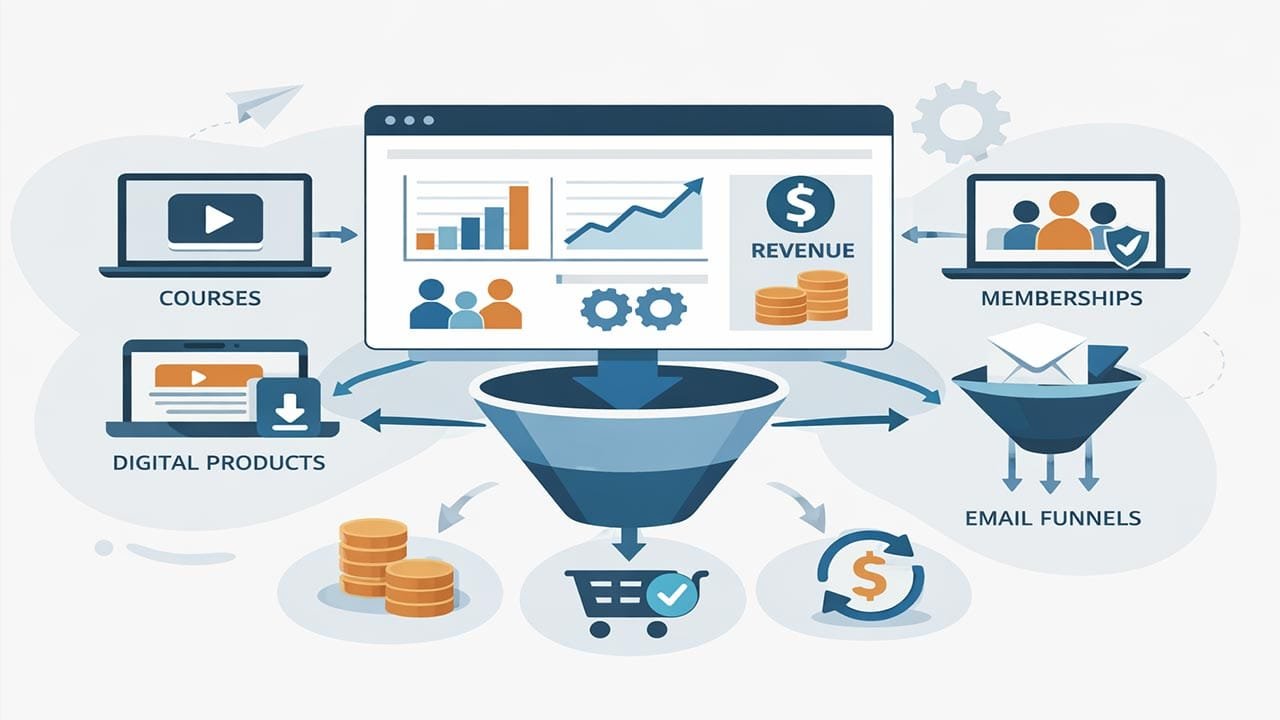
Monetization & Content Business Models
A modern content business is no longer built on traffic alone. Sustainable creator income comes from owning distribution, aligning monetization with audience intent, and designing scalable revenue systems. This page breaks down the most effective monetization and content business models for solopreneurs and serious creators who want predictable, compounding income rather than one-off wins.
Table of Contents
- The Shift From Content to Content Businesses
- Core Monetization Principles Every Creator Must Understand
- Audience-Led Monetization Models
- Productized Knowledge & Digital Assets
- Subscription, Membership, and Recurring Revenue
- From Services to Scalable Offers
- Funnels, Ecosystems, and Revenue Stacking
- Common Monetization Mistakes Creators Make
- The Future of Content Monetization
- Top 5 Frequently Asked Questions
- Final Thoughts
- Resources
The Shift From Content to Content Businesses
The creator economy has matured. Platforms reward consistency, but they rarely reward ownership. Successful creators now think like operators, not influencers. A content business is defined by three assets: audience trust, proprietary knowledge, and controlled distribution. Monetization is no longer an afterthought. It is designed alongside content strategy from day one.
Creators who rely solely on ad revenue or brand deals are exposed to platform volatility, algorithm changes, and pricing compression. In contrast, creators who build businesses around education, transformation, and outcomes generate higher lifetime value per follower and far greater resilience.
Core Monetization Principles Every Creator Must Understand
Every monetization strategy rests on a small set of immutable principles. First, value precedes revenue. Audiences pay when content consistently reduces time, risk, or uncertainty. Second, monetization must match intent. Entertainment monetizes differently than problem-solving content. Third, leverage compounds income. Products that sell without proportional increases in time outperform services long term.
Price anchoring, outcome clarity, and audience segmentation are not marketing tactics; they are structural advantages. Creators who understand these fundamentals can monetize smaller audiences more effectively than those chasing scale without strategy.
Audience-Led Monetization Models
Audience-led monetization starts with relationship depth rather than reach. Models such as sponsorships, affiliate marketing, and paid recommendations work best when trust is high and alignment is tight.
Affiliate monetization succeeds when creators use products publicly and integrate them naturally into workflows. Performance-based revenue favors creators who teach implementation rather than promote features. Sponsorships increasingly favor niche creators with high conversion density rather than mass reach.
However, these models are income-reactive. They respond to traffic, trends, and external demand. Serious creators treat them as supplemental rather than foundational revenue.
Productized Knowledge & Digital Assets
Productized knowledge transforms expertise into scalable assets. Courses, playbooks, templates, and frameworks decouple income from hours worked. The highest-performing digital products solve a narrow, urgent problem for a clearly defined audience.
Premium education outperforms low-cost products when transformation is explicit. Buyers pay for speed, clarity, and confidence. Cohort-based courses, implementation-focused programs, and outcome-driven curriculums consistently outperform passive video libraries.
Intellectual property compounds. Once created, it can be refined, bundled, licensed, or layered into higher-ticket offers.
Subscription, Membership, and Recurring Revenue
Recurring revenue stabilizes creator income and increases valuation. Membership models work when ongoing value exists through community, updates, access, or accountability. The mistake many creators make is gating static content instead of delivering continuous progress.
Successful memberships evolve with the audience. They offer layered value such as office hours, private communities, content drops, and direct feedback loops. Retention matters more than acquisition. A smaller, highly engaged membership outperforms a large disengaged one.
Subscriptions shift the creator mindset from launching to serving. They reward consistency, responsiveness, and long-term thinking.
From Services to Scalable Offers
Services are often the starting point of creator monetization. Consulting, coaching, and freelance work validate demand and generate early cash flow. The strategic mistake is staying there too long.
High-leverage creators productize services by identifying repeatable problems and standardizing solutions. Group coaching replaces one-to-one delivery. Frameworks replace custom strategy. Systems replace improvisation.
Services become laboratories. Insights gained there inform scalable offers that preserve margins while increasing impact.
Funnels, Ecosystems, and Revenue Stacking
Modern content businesses operate as ecosystems, not funnels. Free content attracts attention. Lead magnets convert interest into owned audiences. Entry products qualify buyers. Premium programs deliver transformation.
Revenue stacking increases lifetime value without increasing acquisition costs. A single audience member may progress through multiple offers over time. The key is sequencing. Each offer prepares the buyer for the next level of commitment.
Email lists, communities, and first-party data are the connective tissue of this ecosystem. Platforms drive discovery. Owned channels drive revenue.
Common Monetization Mistakes Creators Make
The most common mistake is monetizing too early without clarity. Another is copying models without matching audience intent. Many creators underprice due to confidence gaps, then overwork to compensate.
Over-diversification fragments focus. Under-investment in distribution limits scale. Ignoring backend offers caps growth. Monetization failures are rarely about effort; they are about structure.
The Future of Content Monetization
The future favors ownership, trust, and depth. AI increases content supply, making curation, insight, and interpretation more valuable. Audiences will pay for clarity in noisy markets.
Hybrid models will dominate. Education plus community. Content plus tools. Personal brand plus institutional credibility. Creators who think like founders will outpace those who think like publishers.
Top 5 Frequently Asked Questions
Final Thoughts
A content business is not built by chasing views. It is built by designing value paths. Monetization is strategy, not tactics. When creators align audience needs, owned distribution, and scalable offers, revenue becomes predictable and compounding.
The most successful creators are not the loudest. They are the most intentional. Monetization rewards clarity, patience, and systems thinking.
Resources
- Stripe Creator Economy Report
- SignalFire Creator Economy Market Map
- Harvard Business Review on Subscription Models
- Gumroad Creator Revenue Insights

Related Monetization & Content Business Models Learning…
Continue learning other topics…

Chatbots in 2024, AI Predictions for Advancement
Predictions for AI Chatbots in 2024 and Future Advancements in Chatbot Technology Chatbots in 2024 will [...]

AI Consumer Engagement
AI Consumer Engagement: Harnessing the Power AI Consumer Engagement in the rapidly evolving world of customer [...]

Marketing with ChatGPT
Digital Marketing & ChatGPT: Revolutionizing Strategies Marketing with ChatGPT is leveraging the capabilities of AI, marketers [...]

ChatGPT Prompt to create a Sales Funnel
ChatGPT Prompt will save you and I time, a lot of time! I've been using ChatGPT [...]

Monetizing Your Blog
Monetizing Your Blog: Strategies for Generating Revenue Monetizing your blog isn't just a dream; it's a [...]