


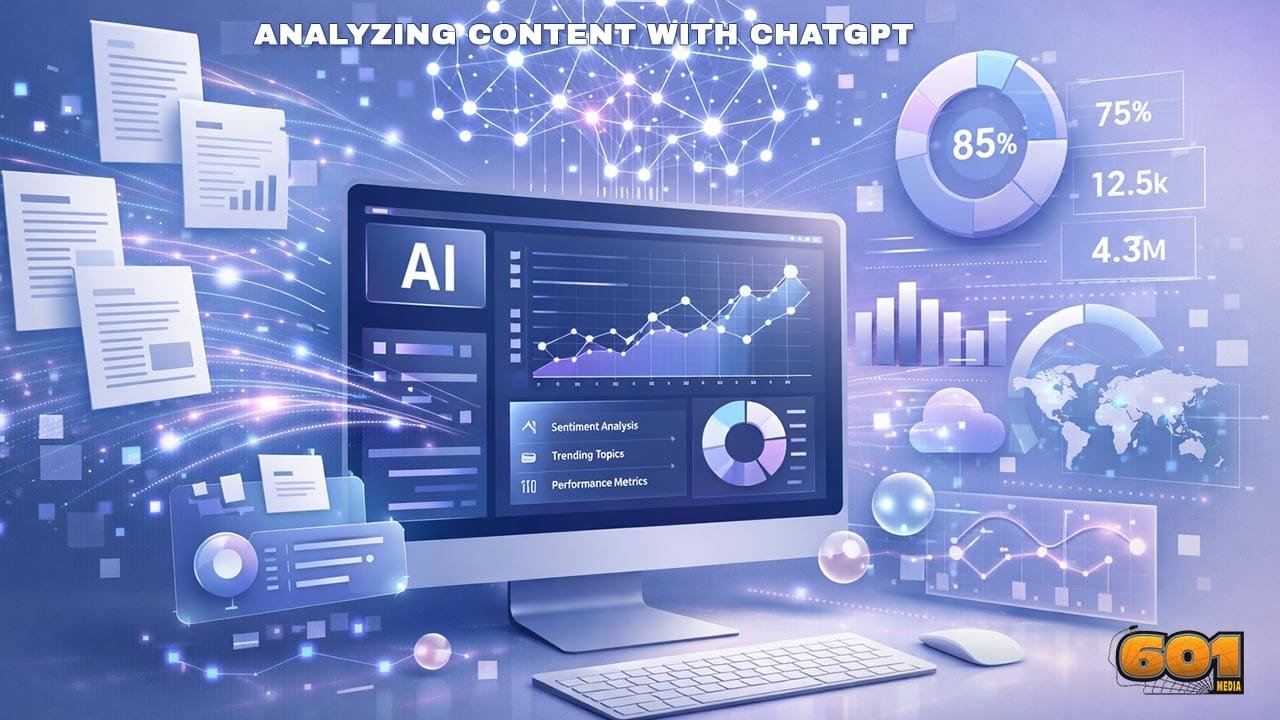
Introduction to Analyzing Content with ChatGPT
Todays article explores Analyzing Content with ChatGPT and how it can be used as a practical and strategic tool for analyzing digital content. It explains core concepts, workflows, benefits, limitations, and real-world use cases for marketers, product teams, researchers, and technology leaders seeking data-informed content decisions.
Table of Contents
- Understanding Content Analysis in the AI Era
- What ChatGPT Is and How It Works
- Key Content Analysis Use Cases
- How to Analyze Content Using ChatGPT
- Business and Strategic Value
- Limitations and Risks
- Best Practices for Reliable Analysis
- The Future of AI-Assisted Content Analysis
- Frequently Asked Questions
- Final Thoughts
- Resources
Understanding Content Analysis in the AI Era
Content analysis is the systematic examination of written, visual, or spoken material to extract meaning, patterns, intent, and quality. Traditionally, this process relied on manual review, keyword counting, sentiment scoring, or rule-based software. These methods were often time-consuming, expensive, and limited in scope.
Artificial intelligence fundamentally changes this landscape. Large language models can interpret language contextually rather than mechanically. Instead of simply counting words, they evaluate tone, structure, clarity, relevance, and intent across large datasets in seconds.
In the AI era, content analysis is no longer a support function. It becomes a strategic capability that informs marketing performance, product messaging, customer experience, and knowledge management. ChatGPT sits at the center of this shift by making advanced language analysis accessible without technical expertise.
What ChatGPT Is and How It Works
ChatGPT is a generative AI system trained on large volumes of text data using transformer-based neural networks. It predicts language patterns based on probability, context, and semantic relationships. This enables it to summarize, classify, compare, evaluate, and rewrite content with high linguistic fluency.
For content analysis, ChatGPT functions less like a chatbot and more like an intelligent analyst. When given structured prompts, it can:
- Identify themes and topics
- Detect sentiment and emotional tone
- Evaluate clarity, coherence, and readability
- Compare multiple content assets
- Extract insights from qualitative text
Unlike traditional analytics tools, ChatGPT does not require predefined taxonomies. It adapts to the language presented, making it especially effective for unstructured data such as blogs, reviews, transcripts, emails, and social media content.
Key Content Analysis Use Cases
ChatGPT supports a wide range of content analysis applications across industries.
Marketing teams use it to audit blog performance, assess brand voice consistency, analyze competitor messaging, and optimize SEO alignment. Instead of reviewing hundreds of pages manually, teams can identify gaps and opportunities quickly.
Product and UX teams analyze customer feedback, app reviews, and support tickets to surface recurring pain points and feature requests. ChatGPT helps convert qualitative feedback into actionable insight.
Researchers and analysts apply ChatGPT to interview transcripts, survey responses, and reports. It accelerates thematic analysis and hypothesis generation while preserving nuance.
Internal communications teams evaluate clarity, tone, and inclusivity in corporate messaging, policies, and training materials.
Across all use cases, the value lies in speed, scale, and contextual understanding.
How to Analyze Content Using ChatGPT
Effective content analysis with ChatGPT follows a structured methodology rather than casual prompting.
The first step is defining the analytical objective. This may include evaluating sentiment, identifying themes, assessing quality, or benchmarking performance. Clear objectives guide prompt design.
Next, content is provided in manageable segments. Long documents should be broken into logical sections to preserve accuracy and coherence.
Prompt framing is critical. Instead of asking general questions, analysts should specify criteria, perspective, and output format. For example, requesting strengths, weaknesses, and improvement opportunities yields more actionable insights than asking for a general review.
Iteration strengthens results. Analysts refine prompts, request clarification, and compare outputs across multiple runs to reduce bias and improve reliability.
Finally, human validation remains essential. ChatGPT supports analysis, but decisions should be confirmed through expert judgment and supplementary data.
Business and Strategic Value
From a business perspective, ChatGPT-driven content analysis delivers measurable value.
Time efficiency improves dramatically. Tasks that once took weeks can be completed in hours. This accelerates decision-making and shortens feedback loops.
Cost efficiency increases as reliance on manual review or external analysis services decreases. Teams gain analytical capability without expanding headcount.
Strategic clarity improves because insights are derived consistently across content types. Leaders gain a clearer understanding of messaging alignment, customer sentiment, and information gaps.
Most importantly, ChatGPT enables organizations to treat content as a data asset rather than a static artifact. This shift supports continuous optimization and learning.
Limitations and Risks
Despite its strengths, ChatGPT is not without limitations.
It does not possess true understanding or domain awareness beyond patterns in data. This means it may generate plausible but incorrect interpretations if prompts lack context.
Bias remains a concern. Outputs can reflect biases present in training data or introduced through prompt framing.
ChatGPT also lacks real-time awareness unless connected to updated data sources. Analysis of current events or rapidly changing topics may be incomplete.
Confidentiality and data governance are critical considerations. Sensitive or proprietary content should only be analyzed within secure, approved environments.
Understanding these limitations ensures responsible and effective use.
Best Practices for Reliable Analysis
To maximize accuracy and value, several best practices should be followed.
Use structured prompts with clear evaluation criteria. Ambiguity leads to inconsistent outputs.
Cross-validate insights by running multiple prompt variations and comparing results.
Combine AI analysis with quantitative metrics such as engagement data, conversion rates, or survey scores.
Document prompt frameworks and analysis logic to ensure repeatability and transparency.
Train teams to interpret AI output critically rather than treating it as authoritative.
When integrated thoughtfully, ChatGPT becomes a force multiplier rather than a decision-maker.
The Future of AI-Assisted Content Analysis
The future of content analysis lies in deeper integration between AI systems and business workflows.
Advances in multimodal models will allow analysis of text, images, audio, and video simultaneously. Real-time content optimization will become standard practice.
AI tools will increasingly support predictive insights, suggesting not only what content says today but how it is likely to perform tomorrow.
For innovation and technology leaders, mastering AI-assisted content analysis will be a competitive advantage. It enables faster learning, sharper messaging, and more informed strategic decisions.
Top 5 Frequently Asked Questions
Final Thoughts
Analyzing content with ChatGPT represents a fundamental shift in how organizations extract value from language. The technology transforms content from a passive output into an active source of insight. When applied thoughtfully, it enables faster decisions, deeper understanding, and more effective communication. The true advantage lies not in automation alone, but in augmenting human intelligence with scalable analytical capability.
Resources
- McKinsey Digital – AI and Analytics Insights
- IBM – Natural Language Processing Explained
- Nature – Large Language Models Overview






Leave A Comment