


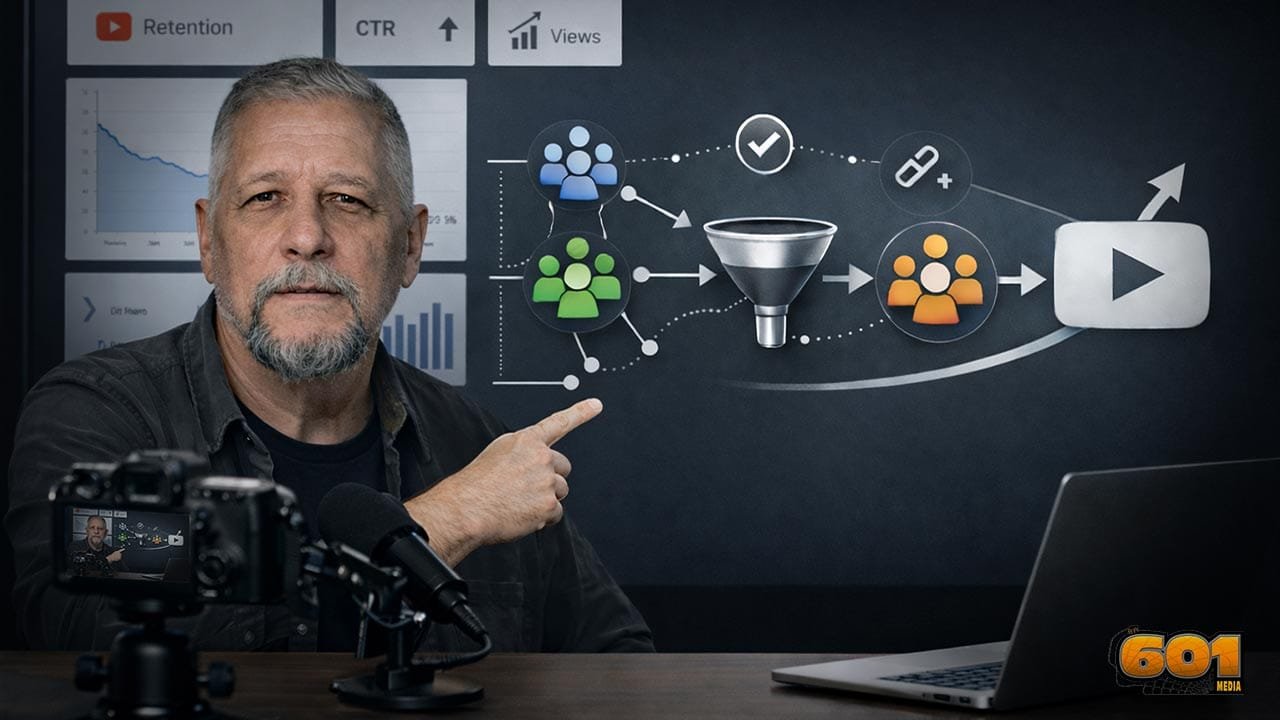
How YouTube Really Decides Who Gets Views: The Non-Random System Behind “Overnight” Growth
If your YouTube channel feels stuck, the worst assumption you can make is that YouTube is “random.” YouTube isn’t guessing—and it isn’t “favoring big channels” as a default setting either. YouTube operates like a high-stakes recommendation and search ecosystem designed to keep viewers satisfied and watching. That means it behaves less like a talent scout and more like a cautious matchmaker. It doesn’t want to introduce viewers to content that feels irrelevant, disappointing, or confusing. Your growth, then, isn’t about being universally “good.” It’s about being clearly good for someone specific—and making it easy for YouTube to prove that quickly.
Table of Contents
- The Algorithm Isn’t a Lottery: It’s a Risk Management System
- Your Audience Already Exists — Your Channel Needs an Introduction
- YouTube Tests Small First — Not Because You’re Small, But Because It’s Verifying Fit
- The Platform Doesn’t Score Videos Universally — It Scores Match Quality
- YouTube Doesn’t See Individuals — It Sees Behavioral Clusters
- Confusion Is the Silent Growth Killer (More Than “Bad Quality”)
- YouTube Is a Matchmaker: It Needs Clarity to Make Introductions
- “Trust” Is the Real Currency: Your Videos Earn a Distribution Confidence Level
- The Three Signals That Build Confidence Fast
- The Biggest Mistake: Pivoting Without a Strategy (The “Reset Tax”)
- Why Some “Average” Creators Win: They Are Easy to Understand
- The Underused Growth Lever: Session Continuation (What Happens After Your Video)
- Practical Channel Operations: How to Make Your “Cluster” Obvious
- What to Fix If You’re Stuck at 100–300 Views
- Top 5 Frequently Asked Questions
- Final Thoughts: YouTube Growth Is Earned Through Clarity and Proof
The Algorithm Isn’t a Lottery: It’s a Risk Management System
YouTube has one core business objective: keep people on the platform longer by recommending content they’ll likely enjoy. Every bad recommendation creates friction. Friction leads to shorter sessions, fewer ads shown, and weaker viewer trust. So YouTube is structurally incentivized to be careful, not adventurous. From an operations standpoint, this explains the behavior creators interpret as “YouTube won’t push my content.” In reality, YouTube is reluctant to expand distribution until it has enough evidence that your video will land well with a particular audience. That evidence comes from behavioral data, not creator effort. In other words: YouTube doesn’t owe your upload a chance at mass exposure. It earns confidence through signals. If your signals are unclear, inconsistent, or mixed, YouTube will protect viewers (and itself) by limiting distribution.
Your Audience Already Exists — Your Channel Needs an Introduction
One of the strongest strategic reframes for creators is this: you are not “building” an audience from nothing. Your audience is already on YouTube, already watching content in your category, already demonstrating what they click, what they ignore, and what they binge. Your job is not to invent demand. Your job is to align with an existing demand cluster and make YouTube confident enough to introduce you. This is why creators who treat YouTube like a distribution engine (and design for clarity) can grow faster than creators who treat YouTube like a portfolio (and design for self-expression). Expression is valuable, but YouTube rewards expression that’s packaged into an instantly recognizable value proposition.
YouTube Tests Small First — Not Because You’re Small, But Because It’s Verifying Fit
Almost every upload begins with a relatively small test. The initial distribution might look like “only 100–500 impressions,” sometimes more, sometimes less, depending on channel history and topic. That can feel insulting if you put hours into production. But it’s not a judgment of your worth. It’s YouTube’s quality control step. The crucial detail: this test is not simply “did they click?” It’s “did the right people click, and did their behavior confirm intent satisfaction?” If you want to grow, you need to stop asking, “Why won’t YouTube show my video?” and start asking, “How quickly does my video prove who it’s for, and how strongly does it satisfy that group compared to alternatives?”
The Platform Doesn’t Score Videos Universally — It Scores Match Quality
Creators talk about “good content” as if YouTube has a single scoreboard. It doesn’t. A “great” video about Facebook ads can be amazing for marketers and useless for someone looking for a gluten-free brownie recipe. YouTube’s job is to avoid that mismatch. So instead of thinking “quality,” think “fit.”
Fit is a combination of:
- Viewer intent: What problem are they trying to solve right now?
- Expectation alignment: Does the title/thumbnail promise match the first 30–60 seconds?
- Audience sophistication: Is it beginner, intermediate, or advanced—and is that obvious?
- Format preference: Do they want a tutorial, a breakdown, a commentary, a story, or a checklist?
A video can be objectively well-made and still underperform because it’s not clearly positioned for a particular group—or it’s positioned for multiple groups at once, which creates confusion.
YouTube Doesn’t See Individuals — It Sees Behavioral Clusters
The most useful mental model from the discussion is that YouTube segments viewers into clusters based on behavior patterns, not demographics. These clusters are built from what people watch, what they search, what they skip, how long they stay, what they watch next, and whether they keep a session going. From a channel operations perspective, that means YouTube growth is basically a categorization problem. Your channel doesn’t “grow” until YouTube can confidently place you into an ecosystem of related content and audiences. Once your video resonates with a cluster, YouTube can widen the net to others with similar behavior patterns. That expansion looks like a sudden breakout, but it’s really a confident match being repeated at scale. This is why creators sometimes experience a “video six” moment—five videos do little, then suddenly one spikes. The content didn’t magically become better overnight. The platform simply accumulated enough pattern evidence to make stronger introductions.
Confusion Is the Silent Growth Killer (More Than “Bad Quality”)
If I had to choose one concept that explains most stalled channels, it’s confusion. Confusion comes from a channel that changes its promise too often. When your last 10 uploads are scattered across unrelated topics, YouTube cannot confidently assign you to a cluster. Think of your channel as a storefront. If the sign changes every week—fitness today, camera gear tomorrow, productivity next week—people don’t know why they should return. YouTube behaves similarly: inconsistent signals slow down learning, which slows down distribution. Creators often rationalize this scatter as “experimenting.” Experimentation is valuable, but it must be structured. Unstructured experimentation trains the algorithm to hesitate.
YouTube Is a Matchmaker: It Needs Clarity to Make Introductions
Matchmaking is a better metaphor than broadcasting. A matchmaker can only connect people when the identities are clear. If your content identity is unstable, you force YouTube to restart the matchmaking process repeatedly.
Practically, clarity looks like this:
- A consistent audience (who you serve)
- A consistent transformation (what changes for them)
- A consistent content “lane” (the kind of problems you solve)
- A consistent packaging style (so viewers recognize you)
YouTube is not trying to reward you for effort. It’s trying to reduce viewer risk. Clarity reduces risk.
“Trust” Is the Real Currency: Your Videos Earn a Distribution Confidence Level
The discussion frames YouTube’s decision-making like a trust score. I’d describe it as distribution confidence. YouTube watches the early response and decides how aggressively it should expand reach.
Here’s a practical way to think about it:
- Low confidence: Minimal expansion, video stalls early.
- Cautious confidence: Slow trickle of impressions, YouTube keeps checking signals.
- Moderate confidence: Stable distribution inside a known cluster, steady growth.
- High confidence: Aggressive expansion to similar viewers, breakout behavior.
Creators often assume the difference between moderate and high confidence is editing, camera, or a “better thumbnail.” Those can help. But the bigger lever is how fast you prove who the video is for and how well you satisfy that group relative to competing videos.
The Three Signals That Build Confidence Fast
From a channel growth systems perspective, there are three core signal categories you should design around.
Signal A: Topic Consistency (Pattern Recognition)
YouTube learns via patterns. Consistent topics make your channel legible. If your uploads are about one coherent domain, YouTube can identify your intended cluster faster. Consistency doesn’t mean repeating the same video. It means consistent audience and intent.
For example, a creator serving “entrepreneurs using content to grow” can publish:
- content strategy breakdowns
- thumbnail/title packaging studies
- audience research tutorials
- systems for scripting and batching
- case studies of channel audits
Same audience, different angles. That’s consistency that scales.
Signal B: Viewer Overlap (Ecosystem Mapping)
YouTube cares about which other channels your viewers watch. If your audience also watches known creators in a niche, YouTube can quickly place you into that niche’s recommendation pathways. This is why niche clarity matters so much. A clear niche creates stronger viewer overlap. Strong overlap creates easier classification. Easy classification creates more impressions. Operational implication: your early content should be intentionally adjacent to established “ecosystem” topics so YouTube can connect the dots. Later, once you’re firmly placed, you can widen creatively.
Signal C: Relative Retention (Performance Versus Alternatives)
Retention is not just “how long they watched.” It’s how your video performs compared to other videos serving similar intent and duration. If you hold attention better than the category norm, YouTube reads that as strong satisfaction. Most creators try to brute-force retention with editing tricks.
The real retention driver is structure:
- Clear promise in the first 15–30 seconds
- Fast context, no long warm-up
- Logical steps and signposts (“here’s what we’ll do next”)
- Examples that match the audience’s reality
- Removing detours that don’t serve the promise
Editing supports retention. Structure creates it.
The Biggest Mistake: Pivoting Without a Strategy (The “Reset Tax”)
In operations, there’s a concept called switching cost. Every time you switch processes, you lose momentum and reintroduce complexity. YouTube works the same way: every major topic pivot imposes a reset tax.
When you pivot to a new category, YouTube must:
- retest which viewers respond
- relearn which clusters fit
- rebuild prediction confidence
- re-earn viewer expectations and loyalty
That’s why constant pivots can cost creators years. Not because pivots are “bad,” but because they’re expensive. If you must pivot, do it intentionally:
- Bridge with overlapping topics (adjacent intent)
- Announce and frame it for subscribers (reduce audience shock)
- Run a focused pivot series (don’t bounce back and forth)
- Update channel metadata to match the new identity
Why Some “Average” Creators Win: They Are Easy to Understand
It’s frustrating, but true: some creators with average production outperform creators with superior craftsmanship because they’re easier to categorize and easier to recommend.
The winning creator often does three things well:
- They serve one clear viewer identity (not “everyone”).
- They repeat the same type of promise so YouTube sees a pattern.
- They package videos in a predictable way so viewers click with confidence.
In YouTube, “clarity” is often the real competitive advantage.
The Underused Growth Lever: Session Continuation (What Happens After Your Video)
Creators focus heavily on clicks and watch time, but YouTube also cares about what viewers do next. If your video leads to another video—especially on your channel—that is a strong satisfaction signal.
Operationally, you should design your channel like a guided experience:
- Create video pairs and trilogies (part 1, part 2, part 3)
- Use end screens with a single obvious “next step”
- Build series playlists that match audience journeys
- Use pinned comments to route viewers
Think less like “uploading content” and more like “building paths.” Paths create sessions. Sessions create more recommendations.
Practical Channel Operations: How to Make Your “Cluster” Obvious
If you want YouTube to classify you faster, your operations must support your strategy. Here’s a practical system that works across most education, commentary, and business niches:
Step 1: Define One Primary Audience Sentence
Example format: “I help who achieve result without pain point.” Not because it’s cute branding—but because it forces focus. Everything you publish should map to this sentence.
Step 2: Choose 3–5 Content Pillars (Problems You Solve)
Example for a YouTube growth channel:
- Ideas and positioning
- Packaging (titles/thumbnails)
- Retention and scripting
- Analytics interpretation
- Channel systems and workflows
When you rotate within pillars, you stay consistent while avoiding repetition.
Step 3: Build a “First 10 Videos” Focus Sprint
Instead of random uploads, plan 10 videos that all serve the same audience and connect logically. This is not for the viewer only—it’s for YouTube’s learning process.
Step 4: Standardize Packaging
Use a recognizable style. Not identical thumbnails, but consistent visual language and predictable promise types. If viewers can’t instantly tell what they’ll get, they hesitate. If they hesitate, they don’t click. If they don’t click, YouTube doesn’t expand distribution.
Step 5: Tighten the First 60 Seconds
Your first minute is not “intro.” It’s the contract. It must confirm the title/thumbnail promise, define what’s coming, and start delivering value immediately.
What to Fix If You’re Stuck at 100–300 Views
When creators stall at low views repeatedly, it usually comes down to one of these operational issues:
- Inconsistent topic signals: YouTube can’t classify you.
- Unclear packaging: The right people don’t click.
- Weak opening: Clicks happen, but viewers leave early.
- No “next video” path: The session ends with you.
- Targeting too broad: You’re trying to serve everyone.
Notice what’s missing from the list: camera quality, fancy edits, and expensive gear. Those can help, but they’re rarely the core constraint early on.
Top 5 Frequently Asked Questions
Final Thoughts: YouTube Growth Is Earned Through Clarity and Proof
YouTube is not random. It is cautious. It’s a recommendation engine that expands your reach only when your video produces clear evidence that it satisfies a specific audience cluster. If you take one takeaway from this entire breakdown, make it this: your job is to make it easy for YouTube to understand who your content is for. When you do that—through topic consistency, ecosystem overlap, and strong relative retention—distribution becomes a natural outcome rather than a mystery. Stop trying to “get lucky.” Start designing your channel so the right viewers recognize themselves in your content. That is how you earn the introduction. And once you earn it, growth stops being a grind and starts becoming a system.


Leave A Comment