


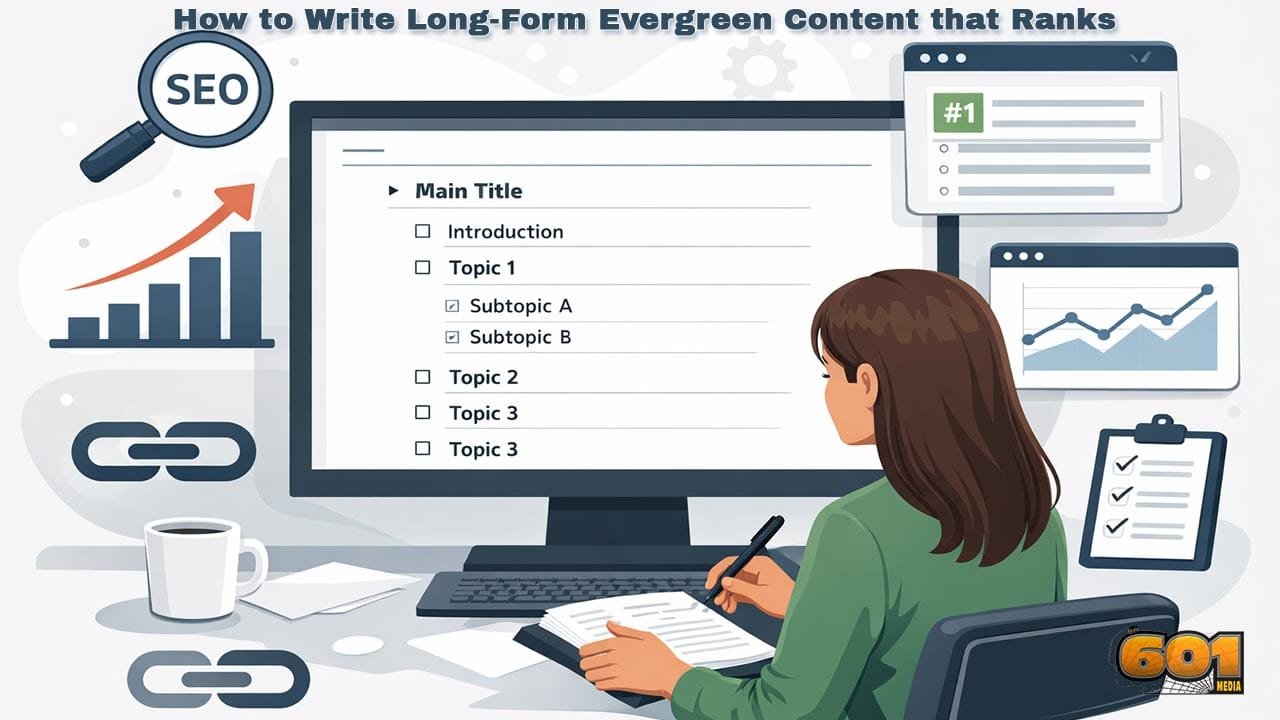
How to Write Long-Form Evergreen Content that Ranks
Long-form evergreen content is the backbone of sustainable organic growth. Unlike trend-based posts that spike and fade, evergreen content compounds value over time, attracting traffic, backlinks, and authority long after publication. Our guide explains how to design, write, and optimize long-form evergreen content that consistently ranks in search engines.
Table of Contents
- What Evergreen Content Really Means
- Why Long-Form Content Dominates Rankings
- Search Intent as the Core Ranking Signal
- Designing Evergreen Content Architecture
- Semantic SEO and Topical Authority
- The Writing Process That Scales
- Internal Linking for Evergreen Power
- Updating Content Without Losing Rankings
- Measuring Evergreen Performance
- Top 5 Frequently Asked Questions
- Final Thoughts
- Resources
What Evergreen Content Really Means
Evergreen content addresses problems, questions, or concepts that remain relevant regardless of time or trends. Topics such as how-to guides, foundational definitions, frameworks, and best practices qualify as evergreen when they are written without date sensitivity and supported by durable principles. Evergreen does not mean static. The most successful evergreen assets are periodically refreshed to maintain accuracy, relevance, and competitive depth. Their value lies in long-term discoverability and consistent search demand.
Why Long-Form Content Dominates Rankings
Long-form content performs well because it satisfies multiple ranking factors simultaneously. Studies consistently show that pages ranking on page one of Google average over 1,400 words, with top three results often exceeding 2,000 words.
Long-form content allows you to:
- Cover topics comprehensively
- Address multiple sub-intents in one URL
- Earn more backlinks due to perceived authority
- Increase dwell time and engagement signals
- Rank for hundreds of long-tail keyword variations
Search engines reward depth when it aligns with user intent. Length alone does not rank content, but depth aligned with clarity does.
Search Intent as the Core Ranking Signal
Evergreen content fails when it targets keywords instead of intent. Modern search engines evaluate whether a page fully satisfies why the user searched.
There are four dominant intent categories:
- Informational
- Navigational
- Commercial investigation
- Transactional
Evergreen long-form content almost always targets informational or commercial investigation intent. Before writing, analyze the top-ranking pages and identify:
- What questions they answer
- What format they use
- What gaps exist
- What assumptions they make about reader knowledge
Your goal is not to replicate competitors but to resolve intent more completely.
Designing Evergreen Content Architecture
High-ranking evergreen content follows a predictable architecture. It moves from general to specific, from definition to application, and from theory to execution.
Effective structure includes:
- A clear conceptual introduction
- Logical section progression
- Scannable subheadings
- Explicit takeaways
- Integrated internal references
This architecture mirrors how humans learn and how search engines understand topical relationships.
Semantic SEO and Topical Authority
Search engines no longer rank pages based solely on exact-match keywords. Semantic SEO focuses on meaning, relationships, and topic coverage.
To build topical authority:
- Use related entities and concepts naturally
- Answer adjacent questions within the same article
- Avoid keyword stuffing
- Use consistent terminology
Long-form evergreen content should function as a topical hub. When paired with supporting articles, it strengthens your site’s overall authority. This reinforces the principle that Content is King when it is strategically interconnected.
The Writing Process That Scales
Writing evergreen content is a system, not an event.
A scalable process includes:
- Research-first outlining
- Search intent validation
- Drafting without optimization
- Optimization without rewriting
- Editorial review for clarity
This separation prevents over-optimization and preserves readability. Tools like AI can assist drafting, but human judgment must guide structure, accuracy, and narrative flow. When used correctly, AI supports workflows such as a ChatGPT SEO Optimized Blog Post without replacing strategic thinking.
Internal Linking for Evergreen Power
Internal links extend the lifespan and authority of evergreen content. They help search engines understand hierarchy while guiding users deeper into your ecosystem.
Best practices include:
- Linking from newer posts to evergreen hubs
- Using descriptive anchor text
- Avoiding over-linking in a single section
- Ensuring contextual relevance
For example, evergreen educational content benefits from linking foundational explanations such as What is a Blog? or advanced breakdowns like an Optimal FAQ Guide. Internal links transform standalone content into a compounding asset.
Updating Content Without Losing Rankings
Evergreen content must evolve without resetting authority. Updates should be incremental, not disruptive.
Safe refresh strategies:
- Add new sections instead of rewriting intros
- Update statistics and examples
- Improve clarity and formatting
- Expand FAQs based on new queries
Avoid changing URLs, core intent, or headline structure unless rankings have declined significantly.
Measuring Evergreen Performance
Evergreen success is measured over months, not days.
Key metrics include:
- Organic traffic growth
- Keyword footprint expansion
- Average ranking position
- Backlink acquisition
- Time on page
Evergreen content that ranks well becomes a predictable traffic engine, reducing reliance on constant publishing.
Top 5 Frequently Asked Questions
Final Thoughts
Long-form evergreen content is not about writing more. It is about writing with permanence in mind. When intent, structure, semantic depth, and internal linking align, evergreen content becomes an asset that compounds authority, trust, and traffic. The brands that win in organic search are not publishing more content. They are publishing fewer pieces that matter longer.
Resources
- Backlinko – Long-Form Content Study
- Google Search Central – Creating Helpful Content
- Ahrefs – Evergreen Content Strategy Guide









Leave A Comment