


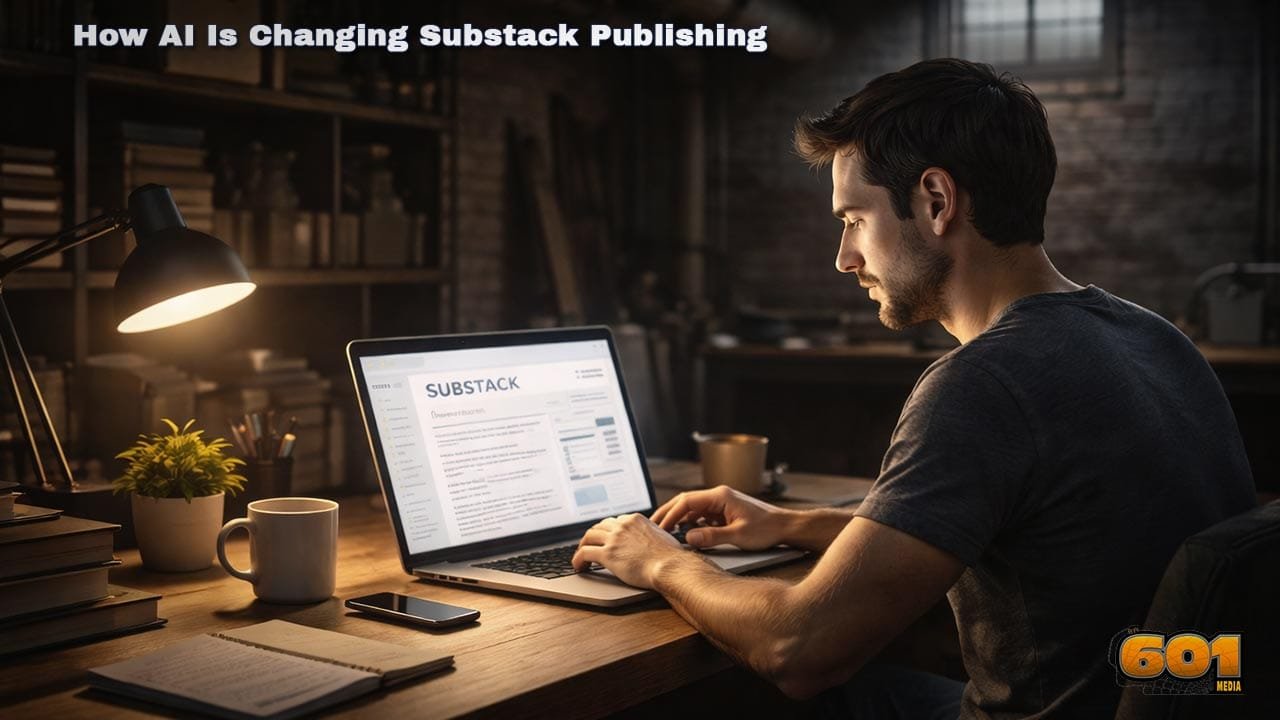
How AI Is Changing Substack Publishing (and Why Early Adopters Win)
Artificial intelligence is quietly reshaping how independent creators research, write, publish, and scale newsletters. On Substack, this shift is especially pronounced. Because the platform rewards consistency, depth, and trust over virality, AI has become a strategic advantage rather than a shortcut. Tools like ChatGPT are not replacing writers on Substack—they are amplifying the creators who know how to use them well. Today we’ll explore how AI is transforming Substack publishing, from idea generation and research to editing, personalization, and automation. It explains why early adopters gain a compounding advantage and how creators can use AI responsibly to increase output, consistency, and revenue without sacrificing voice or trust.
Table of Contents
- Why AI Matters for Substack Right Now
- AI’s Role in the Creator Economy
- AI for Idea Generation and Research
- AI-Assisted Writing and Editing
- Automation, Consistency, and Scale
- Personalization and Reader Experience
- Ethical and Quality Considerations
- Why Early Adopters Win
- Top 5 Frequently Asked Questions
- Final Thoughts
- Resources
Why AI Matters for Substack Right Now
Substack publishing rewards creators who can publish consistently without sacrificing depth. That combination is difficult to sustain manually over long periods. AI matters now because it reduces the cognitive and operational load of publishing, allowing creators to focus their energy where it matters most: insight, perspective, and originality.
In 2026, competition on Substack is no longer about who can write, but who can sustain quality output week after week. AI shortens the distance between idea and execution, which compounds over time.
AI’s Role in the Creator Economy
In the broader creator economy, AI has shifted from novelty to infrastructure. Creators who once relied on teams for research, editing, or distribution can now replicate parts of those workflows solo.
On Substack, this is especially powerful because the business model favors individuals over organizations. AI allows solo creators to operate with leverage, producing work that would otherwise require multiple roles. This lowers barriers to entry and increases the ceiling for independent publishers.
AI for Idea Generation and Research
One of the biggest challenges for newsletter creators is deciding what to write next. AI excels at accelerating this stage. By analyzing themes, summarizing trends, or generating outlines, AI helps creators move past blank-page paralysis.
AI can also support research by synthesizing information, summarizing long documents, and identifying patterns across sources. This does not replace critical thinking, but it dramatically reduces time spent gathering raw material.
Creators who use AI here gain speed without sacrificing substance, especially when they apply their own judgment and domain expertise to refine outputs.
AI-Assisted Writing and Editing
AI-assisted writing is not about generating finished essays verbatim. The most effective creators use AI as a drafting and editing partner. AI can help restructure arguments, improve clarity, tighten prose, and adapt tone.
Editing is where AI delivers outsized value. Many creators struggle more with revision than writing. AI provides instant feedback loops, allowing creators to iterate faster while maintaining their unique voice.
This leads to higher-quality writing with less friction, which directly impacts reader trust and retention.
Automation, Consistency, and Scale
Consistency is one of the strongest predictors of success on Substack. AI enables systems that support consistency without burnout. Editorial calendars, content templates, performance summaries, and repurposing workflows can all be automated.
Automation does not mean publishing more—it means publishing reliably. Creators who miss fewer issues and maintain predictable schedules signal professionalism and commitment, which strengthens authority over time.
As subscriber bases grow, these systems become essential rather than optional.
Personalization and Reader Experience
AI also opens the door to more personalized reader experiences. While Substack itself limits deep personalization, creators can use AI to segment audiences, tailor messaging, and experiment with different content formats for different reader groups.
Personalization increases perceived relevance. Readers who feel understood are more likely to stay subscribed, upgrade to paid tiers, and recommend the publication to others.
Over time, this creates a feedback loop where AI-enhanced insights improve editorial decisions.
Ethical and Quality Considerations
The use of AI raises legitimate concerns around authenticity and trust. Readers subscribe to Substack publications for human perspective, not generic content. Overreliance on AI can erode this if not handled carefully.
The key distinction is assistance versus substitution. AI should support thinking, not replace it. Transparency, editorial judgment, and originality remain essential.
Creators who treat AI as a tool—not a shortcut—maintain credibility while benefiting from efficiency.
Why Early Adopters Win
Early adopters of AI on Substack gain compounding advantages. They learn faster, publish more consistently, and refine workflows ahead of competitors. Over time, these small gains accumulate into stronger brands, deeper reader relationships, and more resilient businesses.
As AI becomes mainstream, the advantage shifts from access to mastery. Creators who experiment early develop intuition about what works and what does not, positioning themselves ahead of the curve.
In publishing, momentum matters. AI accelerates momentum.
Top 5 Frequently Asked Questions
Final Thoughts
The most important takeaway is that AI is not changing what makes Substack successful—it is changing how efficiently creators can deliver it. Insight, trust, and consistency remain the foundation. AI simply lowers the cost of execution. Early adopters who learn to integrate AI thoughtfully will build stronger, more sustainable Substack businesses while others struggle to keep pace.








Leave A Comment