




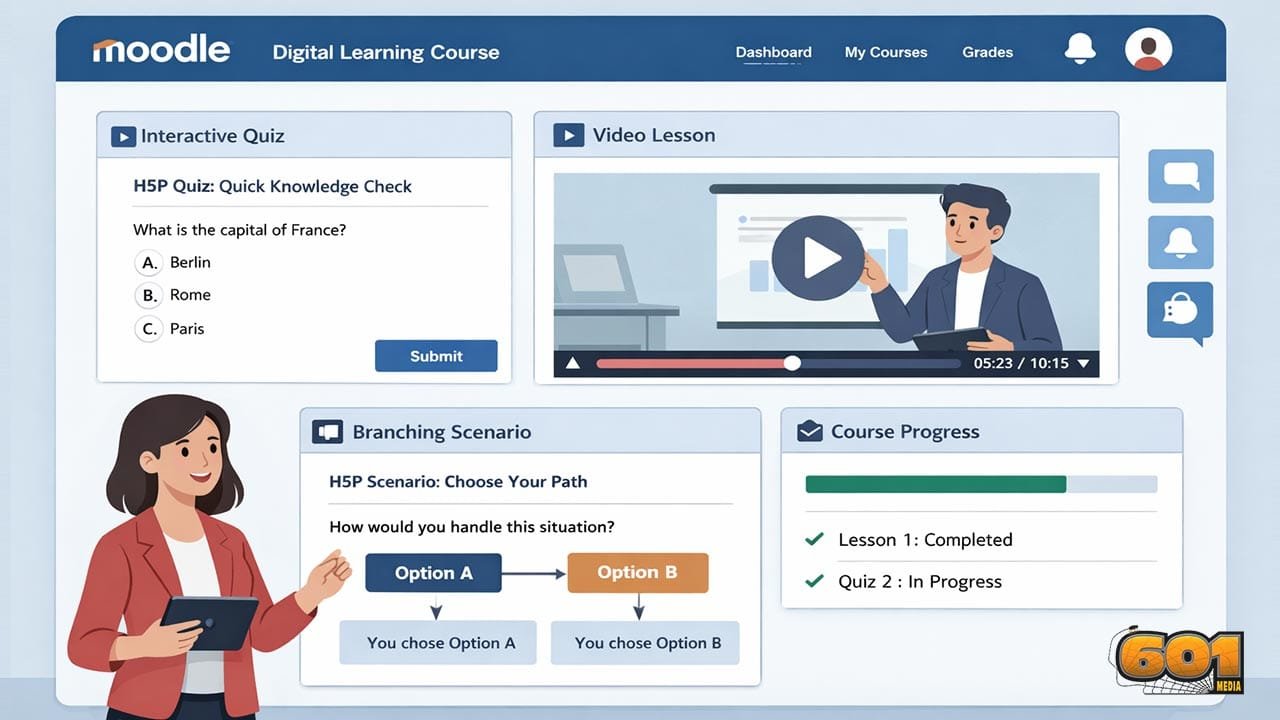
Why Use H5P in Moodle LMS for Better Teaching and Engagement
Interactive learning has moved from being a “nice to have” to an essential component of effective digital education. H5P, when integrated with Moodle LMS, allows educators to transform passive content into engaging, trackable, and pedagogically sound learning experiences—without requiring advanced technical skills. H5P enables instructors using Moodle LMS to design interactive, learner-centered content that improves engagement, retention, and assessment quality. This article explains why H5P is a powerful teaching tool, how it aligns with modern instructional design principles, and where it delivers measurable value in real-world Moodle-based learning environments.
Table of Contents
- What Is H5P and How Does It Work with Moodle?
- The Pedagogical Value of Interactive Learning
- How H5P Improves Student Engagement and Retention
- Enhancing Assessment and Feedback in Moodle
- H5P and Instructional Design Best Practices
- Accessibility and Inclusive Teaching with H5P
- Scalability and Teaching Efficiency
- High-Impact H5P Use Cases in Moodle
- Limitations and Considerations
- Why H5P Is a Future-Ready Choice for Moodle
- Top 5 Frequently Asked Questions
- Final Thoughts
- Resources
What Is H5P and How Does It Work with Moodle?
H5P is an open-source framework that allows educators to create, share, and reuse interactive HTML5 content. Within Moodle LMS, H5P functions as a native content type, meaning instructors can build interactive activities directly inside their courses without relying on third-party platforms. H5P content types include interactive videos, quizzes, branching scenarios, drag-and-drop exercises, presentations, and simulations. These activities can be embedded in lessons, books, or course pages, and—critically—many of them integrate with Moodle’s gradebook. This tight integration makes H5P more than a content add-on; it becomes a core instructional tool that supports both teaching and assessment workflows.
The Pedagogical Value of Interactive Learning
Decades of learning science research show that active learning significantly outperforms passive learning. Students learn more effectively when they interact with content, make decisions, and receive immediate feedback.
H5P supports:
- Constructivist learning by encouraging exploration and self-discovery
- Cognitive engagement through frequent knowledge checks
- Formative assessment embedded within learning materials
Rather than separating “content delivery” from “assessment,” H5P blends them into a single learning experience. This aligns closely with evidence-based teaching models such as Bloom’s Taxonomy and experiential learning theory.
How H5P Improves Student Engagement and Retention
One of the most common challenges in Moodle courses is learner disengagement—especially in asynchronous or fully online environments. Long text pages, static PDFs, and recorded lectures often result in low completion rates.
H5P addresses this by:
- Breaking content into smaller, interactive segments
- Requiring learner input to progress
- Providing immediate feedback that reinforces understanding
Research from online education studies indicates that interactive content can improve knowledge retention by up to 25–60% compared to passive formats. When learners actively respond to questions inside a video or presentation, they are far more likely to remain focused and complete the activity.
Enhancing Assessment and Feedback in Moodle
H5P excels as a formative assessment tool. Instructors can insert low-stakes questions throughout content, helping students self-assess before high-stakes quizzes or exams.
Key assessment benefits include:
- Automatic grading for many activity types
- Immediate, contextual feedback
- Gradebook integration for selected content types
This approach reduces instructor grading workload while increasing the frequency and quality of feedback—one of the strongest predictors of student success.
H5P and Instructional Design Best Practices
From an instructional design perspective, H5P supports:
- Microlearning through short, focused interactions
- Scaffolded learning paths using branching scenarios
- Alignment between learning objectives, activities, and assessments
For example, an interactive video can pause at critical moments to ask application-based questions, ensuring learners understand before moving forward. This design reduces cognitive overload and supports mastery learning.
H5P also encourages reusability and iteration. Content can be duplicated, adapted, and improved over time—an important advantage for institutions managing large Moodle course catalogs.
Accessibility and Inclusive Teaching with H5P
Inclusive education is a growing priority, and H5P supports accessibility standards such as WCAG 2.1 when used correctly.
Accessibility features include:
- Keyboard navigation
- Screen reader compatibility
- Support for captions and transcripts
Instructors can design activities that accommodate different learning preferences, languages, and abilities. Interactive content also allows learners to control pacing, replay sections, and practice skills privately—reducing anxiety and barriers to participation.
Scalability and Teaching Efficiency
For institutions and educators managing large cohorts, scalability matters. H5P enables:
- Consistent learning experiences across multiple course sections
- Reduced reliance on manual grading
- Easy updates without rebuilding entire courses
Once created, H5P content can be reused across programs, departments, or academic years. This efficiency makes it especially valuable in corporate training, higher education, and large-scale online learning initiatives.
High-Impact H5P Use Cases in Moodle
Practical applications of H5P in Moodle include:
- Interactive compliance training modules
- Scenario-based professional skills training
- Language learning with immediate pronunciation feedback
- STEM concept checks embedded in lectures
- Orientation and onboarding courses
These use cases demonstrate how H5P supports both knowledge acquisition and skills development.
Limitations and Considerations
While powerful, H5P is not without limitations. Some advanced analytics are limited compared to specialized assessment tools, and not all content types support gradebook integration.
Effective use requires:
- Thoughtful instructional design
- Testing for accessibility and usability
- Institutional support for updates and maintenance
When used strategically, however, these limitations are outweighed by the pedagogical and operational benefits.
Why H5P Is a Future-Ready Choice for Moodle
H5P aligns with the broader shift toward active, data-informed, and learner-centered education. Its open-source nature, strong Moodle integration, and growing ecosystem make it a sustainable long-term solution. As digital learning continues to evolve, tools that combine flexibility, accessibility, and instructional effectiveness will define successful LMS implementations. H5P stands out as one of the most practical ways to modernize teaching within Moodle—without increasing complexity or cost.
Top 5 Frequently Asked Questions
Final Thoughts
H5P transforms Moodle from a content repository into an active learning environment. Its greatest strength lies in its ability to merge pedagogy, technology, and efficiency into a single tool. For educators seeking higher engagement, better feedback, and scalable course design, H5P is not just an enhancement—it is a strategic teaching asset.
Resources
- H5P Official Documentation
- Moodle Docs – H5P Overview
- OECD – Innovative Learning Environments Research
- EDUCAUSE – Active Learning and Digital Pedagogy Reports



Leave A Comment