




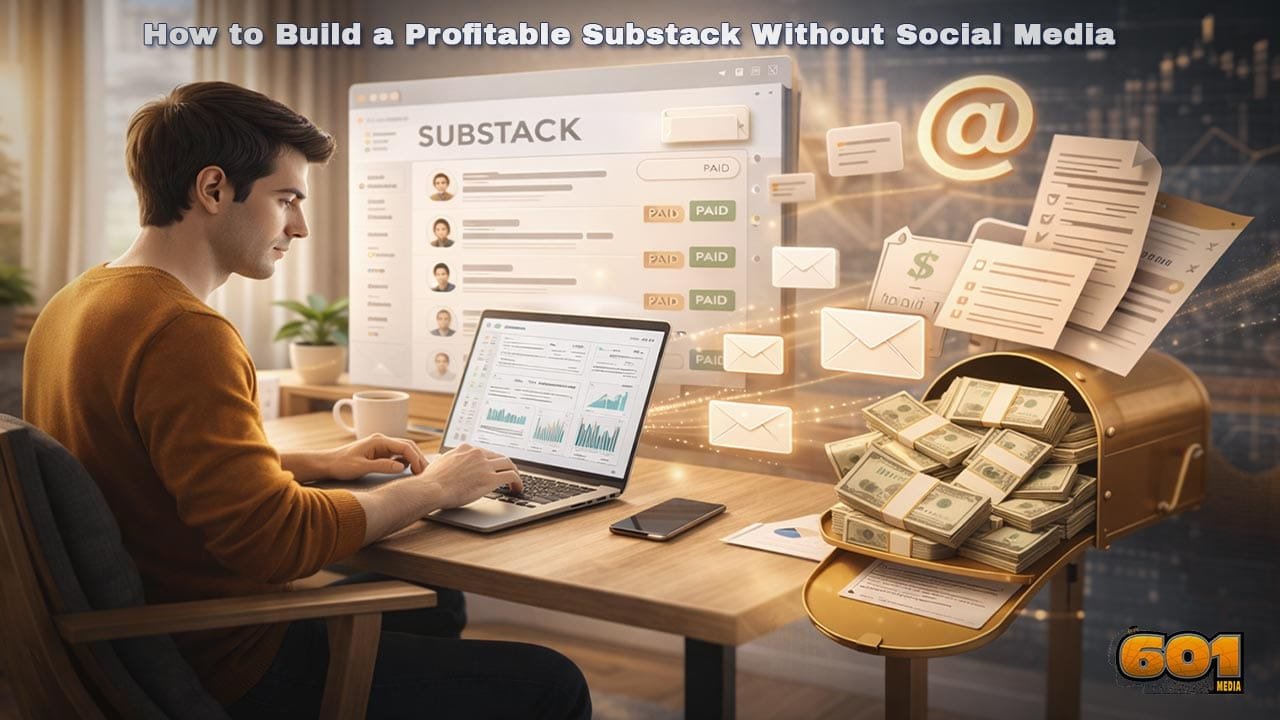
How to Build a Profitable Substack Without a Large Social Media Following
Building a successful Substack does not require viral tweets, massive LinkedIn reach, or an existing audience of tens of thousands. In fact, many of the most sustainable and profitable Substack publications are built quietly, through email-first strategies, niche authority, and trust-based growth. Since its launch, Substack has enabled creators to bypass social media entirely and build direct, reader-funded businesses on their own terms. Todays article explains how creators can build a profitable Substack without relying on a large social media following. It breaks down email-first growth, niche positioning, content strategy, conversion psychology, and scalable systems that prioritize ownership and long-term revenue over algorithm-driven attention.
Table of Contents
- Why Social Media Is Not Required
- The Email-First Creator Economy
- Choosing a Profitable Niche
- Content Strategy Without Virality
- Building Your First 1,000 Subscribers
- Converting Free Readers to Paid Members
- Systems and Automation for Scale
- Common Mistakes to Avoid
- Top 5 Frequently Asked Questions
- Final Thoughts
- Resources
Why Social Media Is Not Required
Social media is often framed as a prerequisite for audience growth, but this belief is increasingly outdated. Platforms reward frequency, outrage, and trend-chasing, not depth or consistency. For creators who want to build a durable business, social media often introduces volatility rather than leverage.
Substack operates on a different logic. Growth does not depend on algorithmic reach but on reader trust. A small group of highly engaged readers can outperform a large but disengaged social following in terms of revenue, retention, and referrals. Because subscriptions are paid, the unit of success is not views or likes, but reader commitment.
This shift allows creators to optimize for quality and relevance rather than scale at all costs. It also reduces burnout, as creators are no longer forced to maintain a constant presence across multiple platforms.
The Email-First Creator Economy
Email remains the most reliable digital distribution channel. Unlike social platforms, email is not governed by opaque algorithms or shifting incentives. When a reader subscribes to a Substack, the creator gains a direct line of communication that cannot be throttled or taken away.
An email-first approach prioritizes relationship-building. Each message lands in a personal inbox, alongside communications from colleagues, friends, and family. This context increases attention and perceived value. Over time, consistent delivery builds familiarity and trust, which are prerequisites for paid subscriptions.
From a business perspective, email also supports predictable revenue. Open rates, churn, and conversion metrics provide clear feedback loops. This allows creators to refine their content and pricing based on real audience behavior rather than platform analytics.
Choosing a Profitable Niche
Profitability on Substack is driven more by specificity than popularity. Broad topics attract casual readers, while narrow niches attract paying subscribers. The most successful publications sit at the intersection of expertise, demand, and willingness to pay.
A profitable niche typically has three characteristics. First, the audience has a clear problem or goal. Second, the information provided is difficult to find elsewhere or requires interpretation. Third, the audience has economic agency, meaning they can afford to pay for insight.
Examples include professional development, industry analysis, investment research, health optimization, and specialized education. Personal storytelling and general commentary can work, but they usually require stronger differentiation or an existing reputation.
Content Strategy Without Virality
Without social media amplification, content strategy must focus on depth, clarity, and consistency. Each post should stand alone as a valuable asset, capable of convincing a first-time reader to subscribe.
Long-form essays perform particularly well in this context. They signal effort, expertise, and seriousness. Rather than chasing trends, successful Substack creators focus on evergreen themes that remain relevant over time.
Structure also matters. Clear positioning, strong openings, and actionable insights increase reader retention. Over time, readers begin to associate the publication with a specific type of value, making subscription decisions easier.
Building Your First 1,000 Subscribers
The first 1,000 subscribers are typically acquired through a combination of personal networks, existing content assets, and search-driven discovery. Email signatures, personal websites, and guest appearances can drive early growth without relying on social feeds.
Cross-promotion with other newsletters is another powerful strategy. Because Substack audiences are already accustomed to email subscriptions, recommendations convert well. Even small publications can benefit from strategic partnerships within adjacent niches.
Consistency is critical at this stage. Regular publishing builds momentum and signals commitment to new readers. Missed issues or irregular schedules undermine trust before it has time to form.
Converting Free Readers to Paid Members
Free subscribers are not the goal; they are the pathway to paid relationships. Conversion depends on perceived value, timing, and clarity. Readers must understand what they will gain by upgrading and why it is worth paying for.
Effective paywalls do not withhold everything. Instead, they showcase value while reserving depth, exclusivity, or access for paying members. Examples include premium essays, deep-dive research, community access, or direct interaction with the creator.
Pricing should reflect confidence rather than caution. Underpricing can signal low value and attract the wrong audience. Many creators find that higher prices result in fewer but more committed subscribers, improving retention and revenue stability.
Systems and Automation for Scale
As a Substack grows, systems become essential. Manual workflows do not scale, especially for creators balancing publishing with other responsibilities. Automation allows consistency without increasing workload.
Content planning, research assistance, and audience segmentation can all be supported by AI tools. Many creators use automation to maintain publishing cadence, personalize communication, and analyze performance trends. This enables sustainable growth without sacrificing quality.
Importantly, systems should support the creator’s voice, not replace it. Automation works best when it handles repetitive tasks, freeing time for thinking, writing, and engagement.
Common Mistakes to Avoid
One common mistake is waiting too long to monetize. While building trust is important, delaying paid offerings can train readers to expect free content indefinitely. Introducing paid options early sets expectations.
Another mistake is overproducing. Quantity does not equal value. Inconsistent quality erodes trust faster than infrequent publishing. Sustainable schedules outperform aggressive ones.
Finally, many creators underestimate positioning. Without a clear value proposition, even excellent writing can struggle to convert. Readers should immediately understand who the newsletter is for and why it matters.
Top 5 Frequently Asked Questions
Final Thoughts
The most important takeaway is that profitability on Substack is not about visibility, but about value. Large social followings are optional; trust and relevance are not. By focusing on email-first relationships, clear positioning, and sustainable systems, creators can build meaningful, independent businesses without chasing algorithms or trends. Substack rewards depth, consistency, and commitment—qualities that compound over time.









Leave A Comment